Friday, December 16, 2011

The Six Hats of a Community Manager


In my previous post, I wrote about the tenets of communitymanagement based on my learnings from the past 6 months. In this post, I want to talk about the different hats that we need to don as community managers. This was well put in the diagram by Andy Wibbels which you can see in this post called Inside the Mind of a Community Manager.It graphically represents a number of things a community manager needs to be aware of in her/his role.

In my post, I want to explore all the "hats" a community manager needs to wear to execute her role. The premise of this post is that when an organisation makes a conscious effort to move towards a more social way of doing business, it usually begins with the introduction of an enterprise collaboration platform. Employees, who have been using emails and, perhaps, mailing lists and google groups till then as their mode of communication and collaboration, are now expected to use the collaboration platform for their day to day business. This shift calls for some intense community management and community building, and the post focuses on the different roles a community manager needs to play during this time.

The hat of a Change Agent
When an organization moves to a different mode of communication, it calls for a huge amount of change management. What we are asking for is a behaviour change. Conceptually, the change may appear to be a very simple one--move from emails to a more open mode of communication on a collaboration platform. However, living in the inbox is a deep-rooted habit for most 21st century workers. And to be honest, email is the most frictionless, asynchronous mode of communication today. Why then will people bother to make the shift?

As change agents, we have to make two things very simple for them -- the act of making the shift and the reason behind the shift. Let's take Amazon as an example. I end up buying books on my Kindle not only because I want those books but also because Amazon makes it incredibly simple for me to buy them. It has changed my reading and buying habits tremendously. And I have changed without appearing to have made any conscious effort to do so.

Similarly, we have to remove obstacles from the path of change. We have to be obsessed with making the shift to the new collaboration platform easy. This of course is easier said than done. There will be umpteenth obstacles beyond the control of a community manager ranging from the constraints posed by the platform itself to enterprise security policies that impact how users access the platform. Make a platform difficult to access--this means anything more than two clicks--and users will exit. Moreover, the steps needed to be taken to make the shift have to be crystal clear including what the expected outcome will be. Dan and Chip Heath says in Switch, "What looks like resistance is often a lack of clarity." Ambiguity will doom any change effort. And they will go back to the default behavior--in this case email. While emails may be a sub-optimal medium of collaboration, human beings will default to known behavior in the absence of clear and easy path to change.

The hat of a Trainer
All new platforms-- no matter how intuitive it may seem--require some training. This can be in the form of simple how-to documents, screencasts, videos, webex sessions, and anything else that you can think of. What is important to remember perhaps is that designing and creating these training materials is not enough. We need to ensure they reach the users. This could mean creating a Training/Help Center on the platform that can be a one-stop shop for users. Reaching out to users proactively to find out if they need help is also recommended. Keeping the training materials crisp and to the point is critical. Mapping the training to typical use cases is also important. Providing generic, platform related information is not too useful. Instead, the training material needs to focus on what are the typical ways users are likely to interact on the platform and why would they need to do so. Shaping the guidelines, screencasts and videos around these use cases can help onboard users quickly to the platform.

The hat of a Content Curator
As people begin to access the platform, get comfortable with the functionalities and features, what comes next is a proliferation of content. At least in an organisation like ThoughtWorks, that is the trend. With the proliferation comes chaos. The activity stream turns into an overwhelming flood and people lose control of their information flow. It is the job of the community manager to go through this flood, pick out content of interest and value for the community and aggregate that in a manner that makes consumption easy. Each platform will have its own functionalities and features that allow a community manager to curate and aggregate. Jive SBS--the platform we use--has certain useful widgets that let us do so. However, the curation part is manual. Moreover, to be a trustworthy and respected content curator, it is important to know the interests, needs and passions of the community. This requires constant engagement with the community, listening to the community and having an eye for detail. I will write more about what makes for a good content curator in a later post.

The hat of a Connector
Collaboration platforms are all about connections--between contet and people, between expertise and need, between skill-sets and projects, between people and people. As community managers, we need to set in place a system that enables findability and accessibility. This could mean anything from inculcating practices like tagging for searchability, helping users to fill out their profiles for findabilty, to manually connecting the nodes. Since community managers have a bird's eye view of their community, they are often best placed to spot a need and a corresponding solution--be it for a certain expertise, content or skillset. The role of a connector is crucial in creating business value for the organisation and is a skill all community managers need to hone.

The hat of a Brand Ambassador 
Needless to say, we need to be cheerleaders for our community. There is no replacement for enthusiasm and passion. Marketing the platform--albeit subtly--is one of the tasks of a community manager. Telling stories of successful use cases, collecting examples of how collaboration is positively impacting workflow, business and innovation and narrating these stories-- all help in branding the community as well as in getting the skeptics on-board. It is important to find the evangelists and believers and encourage them to share their stories.

The hat of a Consultant
This is perhaps the most frequently donned hat and covers a gamut of skills including needs analysis, solution designing, influencing, facilitating, and negotiating. This calls for a post by itself but I will touch upon the key points here. Typically, in an organisation/enterprise, a single community of all employees will not be an effective means of collaboration. They will split into teams and groups driven by many factors from functional areas and interests to roles and projects. These teams will form their own communities with their specific and unique goals and objectives. It's our job to help the teams articulate their objectives and enable them to design their community experience in a manner that supports their objectives. It also entails sharing best practices around collaboration--where collaboration implies fruitful comings together to achieve common objectives. 
Enhanced by Zemanta

Thursday, December 15, 2011

Six Tenets of Community Management: Learnings


I am back again after being away for more than 3 months. I have been somewhat lazy but I also deliberately stayed away from posting as I tried to consolidate and synthesise all that I was learning. I have been playing the role of an enterprise community manager for some time now—6 months to be precise—and thought it would be a good idea to jot down my learnings from the past few months.

This post is directed towards new community managers, who have recently donned the mantle of community management and are perhaps finding that there are more things to do than one had thought of. I have had my successes and failures, stumbled and cursed myself at the end of the day for not having predicted a question or a reaction, stayed up at night reading all possible books on community management from the classic Cultivating Communities of Practice by Etienne Wenger to Jono Bacon’s The Art of the Community—only to realize that no amount of reading will teach me what my living, breathing community will.

I can’t remember where I read it, but this is the quote that inspires me: To solve tough problems, have tough problems. And believe me, in a geeky, hard core technology driven organisation filled with hyper active, questioning geeks like ThoughtWorks, community management is no mean task. It can be exhausting but also exhilarating; challenging yet rewarding; sheer hard work but also a huge amount of fun.
Here are some of learnings crystallized over the past few months.

First tenet (and many have said this before me): It’s about the people.
It’s not about the platform; it’s not about technology; and it’s absolutely definitely not about the community manager. It’s about the people who are the heart and soul of the community.

Second tenet: A community manager is an enabler, a facilitator, a guide.
Our job is to ensure we are there for our community, for our users. We need to be a combination of a 24x7 help desk, a consultant, a trouble-shooter, a listening ear, a bridge, and occasionally a shoulder to cry on.

Third tenet: Be clear and precise in your communication.
Clarity, objectivity and having one’s facts right will go a long way in establishing credibility. Whether engaged in oral communication or drafting a written one for the communities’ consumption—read and re-read for verbosity, ambiguity and obfuscation and remove these. Yes, I just used the word. Basically, never obfuscate. In short be simple, to the point and clear.

Fourth tenet: Be empathetic.
No matter how strongly we feel about the social platform, how firmly we believe in the absolute goodness of social engagement, and how strongly we feel that everyone should just “get it”, put yourself in your community member’s shoes and tread the path they are treading. Ask questions, observe usage patterns and offer help. Being judgmental is a “no no”.

Fifth tenet: Keep your ego at home.
There’s no place for ego in this role. We can’t afford to put ourselves first if we want to be half-way good and trusted community managers.

Sixth tenet: Seed the bright spots and successes.
In the initial days of the launch of a social business platform, most community management effort will be focused on initiating and managing change. And this is the time when a huge amount of frustration can also set in. It often feels like you are taking one step forward only to fall back by three. However, one thing I have learned is that looking for what is not working can be overwhelming, daunting and scary. However, if we can think differently and see what is working, we can replicate the bright spots. Analysing what is working, why some users are engaged and participative, what their usage patterns are like, what imbibes a sense of belonging in them can help us to come up with a “matrix for success.” Replicating this matrix can be a step toward facilitating quicker change.

I am still thinking about the last point and will write more about it in a later post. 

Enhanced by Zemanta

Tuesday, August 16, 2011

5 Questions to Ask When Setting up Communities

While the terms community management and community manager are more popular, I have never found them very comfortable to use. It is perhaps to do with the word management--which reeks of Taylorism, hierarchy, command and control--all the connotations that to me are anathema to creating a sense of belonging, infusing passion, and leading. I am happier with community leadership or community facilitation. A facilitator is an enabler, a helping hand and a guide. Good facilitation should almost be invisible, empowering members to take decisions and actions. Anyhow, I digress. I will leave the deconstruction of the word for another post...

I want to document a few of my initial learning from setting up communities within our organization. But I am leaping ahead. Let me set the stage a bit.

I have mentioned in my earlier post here that we have launched an enterprise-wide collaboration platform powered by Jive. As typically happens--there are early adopters who embraced the change and became active contributors on the platform. Then there are the cautious and the wary, dipping their toes in so to speak--but not quite willing to see all the benefits yet. And of course there are the sceptics--the quiet and the vociferous. To bring these individual users—endowed with diverse abilities, motivated differently, and at various levels of platform adoption—together to form communities is an entirely different kettle of fish. 

Yet, on the surface, it seems fairly straightforward. Create communities (i.e., groups on the platform) pertaining to the key capability areas/practices and people will join their “respective” groups to participate, share knowledge, collaborate to find solutions, have engaging conversations spanning different continents, countries, and time zones. That's the vision! But moving towards it requires carefully thought-out steps, clearing the path, and laying the bed—a process of continuous nurturing, tending, and guiding. No wonder the metaphor of gardening is so popular with community building! It comes closest to describing what needs to be done.

A note of clarification: When I talk about communities here, I am referring to groups of people who come together to achieve a shared purpose, learn from and share with each other, and enhance the group's as well as their own individual capabilities. 

Having tried my hand at helping to set up a few communities at the initial stage of the platform rollout, I learned a few valuable lessons. Because dumping everything I have learned into a single post will make this horribly long and confusing, in this post I have focused on the initial steps to take before setting up a community.

Aside: And my instructional design background is standing me in very good stead indeed. Setting up a community requires the same level of diligent analysis of needs, objectives, and desired output as does the creation of a training design.

Communities/groups in an enterprise setting form to serve different purposes. They operate under vastly different dynamics as compared to voluntary communities that form on the web, and I don't merely mean in terms of membership numbers. Communities within an enterprise have specific objectives to achieve, goals and tasks to collaborate towards—all of which should ideally help the organization to move closer to its overarching goals and vision. What’s more—each community can and will be very different from another—forming to serve entirely different purposes.

Some of these communities may revolve around core skills and capabilities important for the growth of the organization. These will be imbued with the spirit of long-term vision of capability development, sharing of knowledge and solving of complex issues. Others may form for a very specific purpose--around a project, event, or even a task. These are typically time-boxed communities seeing a spate of activities for a short while—used as an online gathering place to share ideas, insights, and conversations. In either case, I have learned that when someone requests for help in setting up a community, it is a good idea to ask:
  1. What are the objectives of the community?
  2. Who are the target members? What are they expected to do when they join the community?
  3. Who is going to tend the community, i.e., facilitate, moderate, and guide members?
  4. What business needs will be solved by the forming of this community?
  5. Who are the stakeholders? Are they all on the same page regarding the community’s goals and objectives? Do they have a shared vision?

Once these basic questions have been sorted out, it is time to design a few simple and concise guidelines for the community leaders as well as the members. Without some concrete points of reference, it is difficult to remain aligned with the community's vision over a period of time. 

I will share my thoughts and learnings around this in the next post...

Sunday, August 14, 2011

From Instructional Design to Enterprise Community Facilitation

This is a long overdue post, the draft of which had been languishing in my dropbox for some time--half forgotten. But finally I felt this needs to see the light of day. I have reached something of a cross-roads in my career, and I wanted to document the process of this arrival. It has been a long and exciting journey so far, dotted with exciting projects, some wonderful clients, and a tremendous amount of learning. But now I am traversing down a new path--albeit one I have wanted to travel for a long time.

An instructional designer by profession who started her career anlayzing learner needs, creating micro-design documents, writing story-boards and discussing the nitty-gritty of course navigation with visual designers, I have long been interested in the power of social, collaborative and informal learning. This interest was initially triggered by Jay Cross' seminal work, Informal Learning, Morten Hansen's Collaboration, Wenger, et al's Cultivating Communities of  Practice, Wenger, White, et al's Digital Habitats, various blogs--primarily those by the ITA members and others like Michele Martin, Nancy White, Dave Pollard, Dave Snowden, Nick Milton, George Siemens--and later, books like Marcia Conner and Tony Bingham's The New Social Learning, and John Hagel and JSB's The Power of Pull. And my own foray into the world of social media with Twitter. And over all of this hovered the Cynefin Framework that Shawn Callaghan's video had introduced me to. So, even while I scripted storyboards and designed programs for corporate elearning courses, consulted with clients on the best possible means of rolling out elearning in their organization, and suggested elearning solutions befitting their problems--from training engineers and mechanincs on fixing motorbikes to navigating a new software--I was on the constant lookout for an opportunity to put into practice the social and informal learning blend into workplace learning.

Learning--especially in today's workplace beset with complexity, rapid change, and new challenges--as we knew it was changing. It had to change for an organization to survive. There was scant time to design courses to address needs that evolved from moment to moment, that was undefined, needed creative solutions, and innovative daring. The age of Connectivism was truly upon us. One's ability to solve a problem or find an answer to a burning issue via one's network was fast becoming the measure of one's success. The age of social learning is here. The age of Collaboration and Participation is here. Powered by enterprise2.0 tools and technology, laden with social media tools and apps, fueled by the Pods and the Pads, social business burst upon the scene. It soon became a buzzword but also showed organizations the path to survival, a way to remain on top of things, to face complexity with agility, to meet cusotmer demands with inovation.

Folks like Andrew McAfee, Dion Hinchcliffe, Sameer Patel, Bill Ives, Riitta Raesmaa, J.P. Rangaswami, Venkatesh Rao, et al. showed the direction to the future of work  All of this led to my growing interest in communities, communities of practices and the art of community managment,  further fueled by Jono Bacon's The Art of Community.

Therefore, when an opportunity to dabble in communities and play a part in designing and enabling a social and collaborative learning environment as an enterprise community facilitator presented itself at ThoughtWorks, I jumped at it with alacrity. My interest in social business expanded beyond the by now well-defined benefits of reduced time to market, increased scope for innovation, customer engagement, and such. I wanted to understand how communities within an enterprise can help build capabilities, enable expertise, and truly transform an organization into a learning organization.

I have seen how thoughtful use of social media can transform individual learning, help build one's PLN, and fuel one's passion. I wanted to now explore the impact of social media, communities and collaboration on orgnizational learning, on the building of a learning organization. This seemed like the perfect opportunity to experience what I had so far been reading and dreaming about.  

Communities would be the building blocks of a successful move towards being a "social business". Cultivating communities would help to build capabilities, develop skill sets and enable the move from being a novice to an expert easier and quicker. However, theoretizing is always easier than practice. And only as I began to actively help set up communities did I realize the challenges, the needs, and the perseverance, patience and hard work required to put into play what I envision.

My ongoing learnings from helping to set up communities will be topics of other posts. However, I couldn't have started on those without setting the stage so to speak... For the foreseeable future, this blog is going to focus on my experiences and stories around setting up communities, enabling collaboration, and learnings. I am grateful for my Instructional Design background which is standing me in good stead on this new road...like a trustworthy friend.     

Thursday, July 21, 2011

Lurking is Not a Static State

Lurking and its role in communities has been on the forefront of my mind for the past few days. It has received a lot of attention in the past from the thought leaders in the realm of learning and the role of communities in personal as well as organizational learning. I have recently taken on enterprise community facilitation and was curious to see how people are interacting on our enterprise collaboration platform. The analytics told me that over 40% of the users are Active Users (a term Jive uses to describe all users who log in to consume content without necessarily interacting with the content in any manner). This is also proved by the fact that many of the groups on this platform have membership of ~300 but obviously not everyone is a Contributing User. They are lurking on the edge, consuming content.


Somehow, the word lurker has become associated with pejorative connotations of people taking from communities without giving back, of not contributing, of being selfish and feeding off the hard work of others. They are the free riders. However, is that truly the case? Would we consider silent participants in a meeting or at presentations lurkers? Not really. They showed up. I think what makes lurking seem dubious in an online environment is that we can't technically "reveal" our engagement. No one can see the engrossed look on my face when I read discussion threads in the Learning and Skills group. A lurker might very well be giving back by performing better at their jobs, by sharing insights with others in the context of their daily work by using the learning gleaned from lurking. This is especially true of communities in enterprises. Since the give back is asymmetric and happens in a different context, this goes unnoticed. Does that mean they should always continue to lurk? I don't quite think that happens. Some of the research material points to a cycle of participation that I have mentioned later.


I recalled some of the posts and articles I had read in the past about lurking as a behavior in online communities and what it indicated, and decided to dig through those again. At this point, I also "serendipitous-ly" stumbled upon a couple of conversations recently that touched upon lurking (this is why I love social media). 
The questions going through my mind were:
  1. Do people learn when lurking?
  2. Is it an indicator of the value of the content being generated on the platform?
  3. When does lurking change to participation?
  4. What can community facilitators do to turn lurkers into participants? 
  5. How is lurking different from non-participation? 
  6. Finally, are lurkers considered as community members?
After digging through the references and some old articles I had saved, these are some of the key points that emerged. 
Etienne Wenger, Nancy White and John D. Smith in Digital Habitats calls lurking "legitimate peripheral participation."
From a community of practice perspective, lurking is interpreted as “legitimate peripheral participation,” a crucial process by which communities offer learning opportunities to those on the periphery. Rather than a simple distinction between active and passive members, this perspective draws attention to the richness of the periphery and the learning enabled (or not) by it. (p. 9)

Etienne Wenger in the Communities of Practice: Learning, meaing and identity explains the five trajectories of participation behavior:

  • Legitimate peripheral participation, not fully participating (lurkers)
  • Inbound, headed toward full participation
  • Insider, fully accepted into the community
  • Boundary, sustaining membership in related communities of practice and “brokering” interactions between them
  • Outbound, in the process of leaving a community
There are subsets of lurkers who are Active Lurkers. In Active lurkers – the hidden asset in online communities, writes: 
Active lurkers are those that may take something from the community and pass it along to others using different channels – so they participate in your word of mouth. Active lurkers also include those people who may visit a customer support community and find a solution to their problem without contributing to the community. Those people derive a lot of value from that community interaction and so does your company since they do not clog up your customer call center. Active lurkers also include those who will contact the original poster through a different channel, like telephone, email, or perhaps a face to face meeting – in effect continuing the conversation outside of the visible public side of the community, but not outside of the community itself.
From Lurking builds commonality
...Sometimes. Lurkers are part of a group's latent energy; good things happen when that energy is activated. Lurkers are part of the all-important weak-tie network, and it's important to keep them engaged, even if engagement does not translate to participation. ... the lurkers are a critical part of the weak-tie network -- they need to understand the concepts being discussed so they can discuss them cogently with people who may be outside the network in question.

Just a couple of days back I read Luis Suarez's post on Social Learning at TELUS by Dan Pontefract, where Dan Pontefract says (and I am quoting Luis Suarez's post here):
You don’t have to have everyone on board to get value: Indeed, something that we have seen ourselves, over at IBM as well with some of our social software tools, like IBM Connections Bookmarks where about 35k fellow IBMers make use of it, yet the entire IBM population of 400k benefit from it, because the search results from our corporate Intranet search engine are injected with those social bookmarks that folks keep adding along. And it looks like the folks at TELUS share a similar experience; while they may not have achieved just yet 100% penetration with their social tools, the ones who are making active use of them are helping everyone else get enough value, perhaps not just producing valuable content, but digesting it as well.
This is, in my opinion, a critical point regarding the adoption of social tools within the enterprise, mainly from the perspective of setting up the right expectations and encouraging those who would want to make use of the tools to use them, while allowing the remaining ones adjust accordingly and figure out by themselves whether they would need to jump in as well or not. Let them figure out the value they would want to get from it is probably as good as it gets in order to allow for knowledge workers to understand how, when, why and what to contribute, whenever they may be ready.
There are communities where we continue to remain as lurkers. This happens due to various reasons. Participation, I think, is a factor/output of multiple variables. Some of these are:
  1. Comfort level with the topic under discussion and having something substantive to say.
  2. The perceived expertise level of the others in the community (if I am out of my depth, I may just lurk).
  3. The place of the community in my daily life (if it is on a topic of peripheral interest, I may just lurk).
  4. The attention/time ratio I can devote.
  5. The feel of the community--does it feel welcoming and generate a sense of belonging, accepting of different opinions, composed of people at different levels of expertise, and so on.
When one or more of the above mentioned participation criteria are not met, users tend to lurk. But, as described above, lurking is not necessarily a bad thing. Lurkers often have weak ties to a community but form bridges between communities. They often try to use their listening engagement to distill many opinions and seek the larger pattern. By virtue of being distant from the core of the activities, they may spread themselves thinly across multiple communities and are in the key position to know what is happening where. And talk about these communities cogently to those external to the communities thus driving users towards the communities. 

Tuesday, June 14, 2011

Big Cat Trail--The Charm of Corbett

Corbett was our final halt, and definitely a fitting end to this year's Big Cat Trail.

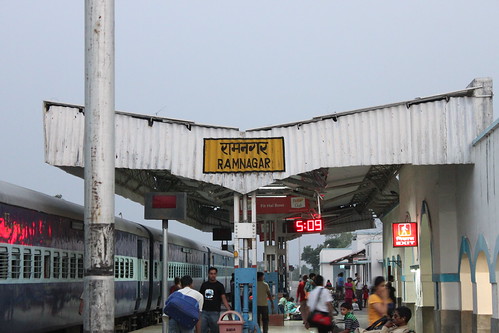
Five o' clock in the morning saw us at the small, quaint station of Ramnagar.  We had boarded our train the previous night from Delhi. The short, comfortable ride was a nice experience.
IMG_8746
Our jeep awaited us at the station and soon we were off-- headed towards Dhikala, where we had managed to get a night's stay. Getting bookings at Dhikala had proved to be an overwhelming and frustrating task accomplished only through Sumeet's perseverance, patience, and I guess, sheer will. Having stayed there, I can only say that I am immensely thankful we got to stay at Dhikala. Without Dhikala, the Corbett experience would have been very different. Disappointing perhaps... Dhikala turned it into a dream. Situated about 60 km inside from the gate, any visit to Corbett would be incomplete without a stay at the Dhikala Lodge.

The drive to Dhikala from the gate took about 2 hours...and that was our first taste of the forest. Corbett is completely unlike any forest we had visited so far. Nestled below the mountain ranges, it is cross-crossed with mountain rivers flowing over rocky beds. These are breathtakingly beautiful, even in the height of summer when the rivers had mostly run dry. This exposed the underlying beds of multi-colored stones weathered and smoothened by the years of rain, sun and shine. The sun's rays falling on these made them glisten like semi-precious jewels, of intriguing shapes and sizes...I was completely enamored. They varied in shades from purple to pink, grey to ochre. I particularly loved the violet ones with a hint of white on them...
IMG_8780
On our way we stopped at the Crocodile Point-- a spot above a river from where one can spot crocodiles... We were lucky to catch our first glimpse of one resting on the bank...looking like a log of wood to a large extent. As we went in, I was torn between marveling at the beauty of the forest and looking out for any wildlife that may cross our path. Corbett is also well-known for it's bird life, and this added to my sense of anticipation. We saw a group of four Oriental Hornbills fly overhead--they caught us by surprise and unfortunately, we weren't prepared with our cameras.

In spite of it being Mid-May, this forest still retained its foliage and greenness. I could only try to imagine how dense it would be post monsoon. No wonder everyone had said that spotting the big cat in Corbett is extremely difficult. 

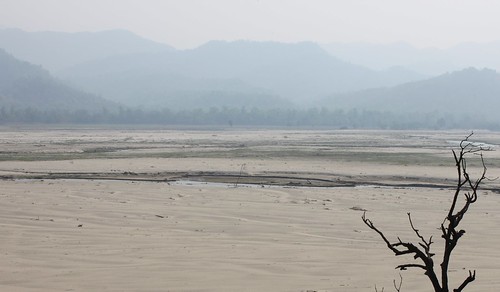
We reached Dhikala around  10 am and headed straight for a sumptuous breakfast. We had the rest of the morning to laze about till our afternoon safari at 4.00 pm. I meandered around the lodge area which is pretty large. It overlooks an enchanting river-bed which was completely dry and formed a sand bank at this time of the year. I was to find out later how beautiful it looked in the moonlight, the whole sandscape turning into a shimmering bed on which the trees cast their huge, dark shadows. It requires a much more proficient writer than I am to capture that beauty in words. All I can say is I could have happily sat there gazing into the night watching the play of moonlight on the sand.
IMG_8835
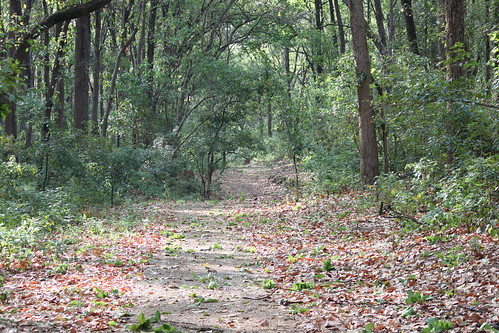
The first safari into Corbett was much awaited by all of us. As our jeep rolled out of the Dhikala gate into the forest, I found myself trying to absorb the feel of the forest with all my senses. Corbett, I realized, had a very distinctive scent made up of dry woods, crushed leaves and the foliage around us. Maybe, other forests do too, but it was in Corbett that I became acutely conscious of this. It was heavenly, almost intoxicating. As we wound our way through, looking to spot bird or mammal, I was constantly pulled into this world of heady fragrance.
IMG_9093
Corbett, we found, is also known for its herd of wild elephants which apparently are prone to charge safari jeeps. Our driver and guide were both on high alert for these animals and regaled us with tales of how they had been caught between a charging elephant in the front and a herd of them at the back. Anyhow, the stories failed to alarm us and we were eager to see a herd. And we did! A huge herd was crossing the meadows when we reached the spot affording us a good view. Later we saw a huge Tusker heading into the forest, pausing now and then to shower himself with sand. It was an impressive sight.
A wild tusker on the move...
That night was an experience I will not forget soon. Around 3 in the night, I woke up to flashes of blinding lightning and an incessant sound of thunder. Rain was falling in sheets...it was an awe-inspiring sight. I stood at the window which very fortunately overlooked the sand bank. The zig-zagging, near blinding flashes would light up the entire scene for long seconds to be followed by ominously loud crashes of thunder. In those seconds of lightning, everything was eerily illuminated-- the sand bank gleamed, the trees looking ghostly in that white light, while the rain lashed down. This high-drama of nature continued for the next two hours and then stopped as abruptly as it had begun. I stepped out around 5.15 am and was greeted by a sparkling clean world, strewn with fallen branches, torn and crushed leaves, and a strange silence. After the night's rampage, the birds were still to start their morning chirping...

We went for our morning safari a little tentatively, our guide warning us that there may not be much to see after such a night. Soon after, belying his words and living up to its reputation for being unpredictable and fickle, nature decided we should have our first glimpse of the big cat in Corbett. She had been sitting on the side of the road down which our jeep traversed. We had missed her because of the dense foliage and had gone ahead. Just then, our guide caught a glimpse and urgently asked our driver to reverse. This caused us to inadvertently block her path and she went inside the undergrowth. We waited not really knowing whether she would make an appearance again. However, her mission of crossing the road was evidently uppermost in her mind. A few seconds later she sprang out--that is all I can say--on to the road, mock-growled at us perhaps for causing her that slight delay, and vanished into the other side with a leap. It was all over within seconds. I think I had stopped breathing and taking a picture had not remotely occurred to me. She was gorgeous...a true Royal Bengal Tigress.

We continued with our safari, pausing to see the avifauna life. We did not see anymore of the big cats in Dhikala but we were not disappointed. Later in the day, we went over to Bijrani, which is much closer to Ramnagar station and hence, gets crowded. It doesn't match up to the Dhikala experience. Nevertheless, the safaris into the forest are always beautiful. This zone is not as replete with birds and other mammals as the Dhikala one but we did see the big cat.

What bothered me were the kind of tourist who came in. They seem to be coming with something like a circus show in mind. Noisy, insensitive to wildlife, and raucous, they detracted from the environment. The forest guides did not seem well-equipped to control tourist behavior. I do think there needs to be an educational program put in place that tell tourists prior to entering the forest, how to behave, what are unacceptable behaviors and the penalties for the same, what to expect, and what wildlife means. And this should be a mandatory part of the safaris. This would also be a good way to raise awareness about wildlife and their status in general.

This is becoming an endless post, and I have not even touched upon the different birds we saw from the red-collared doves to the dollar birds and emerald doves. I think I should wind-up now. Corbett should be on all wildlife lovers list of must-visit forests. It offers one of those rich, unique experiences that is difficult to forget. I am waiting to go back again...
Red-collared dove

Sunday, June 12, 2011

Big Cat Trail--Beautiful Bandhavgarh

For some reason, this has been a post very long in coming...but finally, I have put down my thoughts.

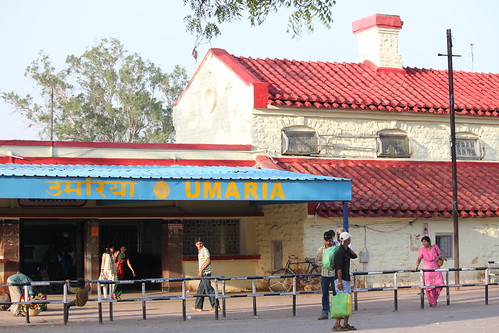
Situated close to In Madhya Pradesh, this was our next destination--our penultimate halt in the Trail. We boarded our train from Jaipur for Umaria, a tiny station probably known for it's proximity to Bandhavgarh. Our pick-up awaited us, and we drove down to the White Tiger Forest Lodge about 30 km from the station. The short ride was a pleasant one. The road was exceptionally well-maintained, and soon we were at our destination. We had the rest of the day to freshen up and rest till the time of our afternoon safari.
IMG_7767
I had heard that tiger spotting in Bandhavgarh is almost a given because of the sheer density. However, our first ride into the park belied this hearsay. The forest is beautiful, like all forests are; however, it lacked a bit of Ranthambore's elegance and mystique.  Anyhow, that did not deter me from enjoying the ride. What perplexed me however was the route system that decreed not only following a specific route (which is completely understandable and should be done to avoid overcrowding of certain sections), but also completing it. This meant, more often than not, that we were driving to complete the route within the stipulated safari hours, hardly stopping to enjoy the wildlife. We also came across forest officials blatantly disregarding any such rule and using forest vehicles to take friends and relatives on tours. This did put us off.

Anyhow, back to the experience. Our first tiger sighting at Bandhavgarh was of the Bokha male and his cubs. This shy tiger was just coming out after having had his drink of water and was climbing up the slope of a small embankment when our jeep arrived at the spot. He is beautiful and as he paused to glance around, I marveled at the grace and strength. He walked up the slope and vanished into the undergrowth. At this point, our safari guide said that we could take an elephant ride inside to see if we could spot him resting.
IMG_8143
Agreeing with alacrity, we mounted our elephant and went in. Sure enough, he was resting under the shade of a tree, and this afforded us ample opportunities to take some close-ups. Just as I was gazing my fill, we heard some commotion and our mahout said, "tiger!" This is a magic word, and we looked up from Bokha. Sure enough, there was a tiger emerging from the forest. He passed very close to our elephant. We were informed that this was one of Bokha's cubs. Happy fortune was with us, and soon the two other cubs soon followed. Full grown in size, they nevertheless stayed together not having yet acquired the hunting skills needed to survive alone.
IMG_8266
I was overjoyed when we saw the legendary Kankatti the next day. She was sitting half submerged in a pool of water hidden by thick undergrowth, shrubs and foliage. Her face had a certain sinister beauty-- perhaps because of her sightless eye. The green leaves partially blocking her face from view added to the mystery. Her good eye glanced at us, sharp and bright. She is a beauty with an attitude.
IMG_8477
When we left Bandhavgarh, I knew I wanted to come back. To see more of the forest, see Kankatti and Bokha and the new male. I just hope and pray that they and the rest of our existing wildlife stay safe. I hope that with rising awareness, we will be able to control poaching, restrict encroachment on wildlife space and grant them the security and peace they need to exist, to survive. We want our tigers to roam our forests with pride and in safety. We don't want to see them on our long list of extinct aimals.
Glowing ornange against rusty red...

Organizations as Communities — Part 2

Yesterday, in a Twitter conversation with Rachel Happe regarding the need for organizations to function as communities, I wrote the follow...