Saturday, June 6, 2009

Informal Learning: People can train you but they can't "learn" you...
As always, Jay Cross gets his points across in a langugae all can understand, identify with, apply.
Some key points:
Informal learning vs. formal learning
1. Informal learning is never over. Its going on all the time.
2. Formal learning has a fixed goal, syllabus and usually ends with some recognition. You know when its over.
3. More than 80% of learning in the workplace is informal learning.
4. Social networks are vital to informal learning.
5. The most powerful educational technology ever invented is human conversation.
6. Social networks are bringing people together; that's why learning takes place.
Organizations and Informal Learning:
1. Four to five times more learning happens in informal training within organizations when compared to formal training.
2. Some steps to take: Legitimizing conversations, make it easy to find one another, read blogs, receive RSS feeds, connect
3. Change the layout of organizations--from individualized cubicles to open sofas where people can gather and talk
The web can bring more experienced and knowledgeable people to contribute and share their knowledge with the youngsters.
The web can bridge and help to transfer the knowledge from the Baby boomers gen (who may soon be retiring from the workforce and take away a tremendous amount of knowhow with them) to the Gamers gen.
Friday, June 5, 2009
What would Dr. Seuss say about online communities...
An excellent presentation that drives home the point using "nonsense rhymes." The appeal of nonsense rhymes dates back to our childhood, and this creates an instant feeling of identificaiton, thus keeping us hooked to the slides. This also increases the recall factor manifold. The rhymes reminded me strongly of Edward Lear's "Owl and Pussy cat" in their pea green boat...
Coupled with the "translation," we are not likely to forget the points about online communities mentioned here in a hurry. By themselves, the points would sound mundane and oft quoted. But now with a rhyme accompanying each one, the message has suddenly come alive.
Enjoy the slideshow...
Coupled with the "translation," we are not likely to forget the points about online communities mentioned here in a hurry. By themselves, the points would sound mundane and oft quoted. But now with a rhyme accompanying each one, the message has suddenly come alive.
Enjoy the slideshow...

L@Fw2008 Dawn Foster
View more OpenOffice presentations from ISITEDesign.

Thursday, June 4, 2009
Wednesday, June 3, 2009
We participate and therefore we are
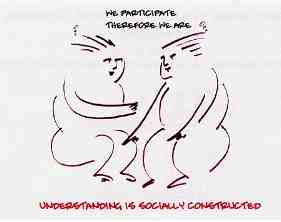
As John Seely Brown says, ~Instead of “I think therefore I am”, it is “We participate and therefore we are”~
Social learning has always been around. And has probably been one of the most effective means of learning as Bandura and Vygotsky had said long back. We turned toward our colleague or friend to ask for help when stuck. We have built communities of practices to facilitate and construct our own understanding. Today, this is being facilitated by technology--making the reach and spread of our learning "groups" wider, more diverse and therefore richer.
Refer to:
Storytelling: Scientist's Perspective: John Seely Brown
We as individuals know very little of most things--only from our individual perspective. Thus, we are often like the blind men feeling an elephant and describing the parts they encounter--but never quite arriving at the whole. In discussion with others, the whole is gradually formed thus enabling us to view the entirety, and arrive at a "holistic understanding"--a much bandied about term.

What is new are the technology and the applications that have evolved and are evolving to support social learning and sharing of knowledge and understanding. These applications, I believe, came into existence because the need was always there. Thus, our natural urge to share, discuss, construct knowledge make us use applications like Twitter to share information thus building our own microcosm of similarly interested people.
Here is a simple analysis that I have done--very simplistic, just highlighting the main drivers, as I see them, of technology being increasingly used to actively support social learning. What has probably made us realize the importance of social learning today and so optimally use the technology available are a combination/juxtaposition of several factors--a very simplistic analysis:
1. Recession
2. Decreased training budget
3. Lack of formal training because of point 2
4. Ever-decreasing shelf life of knowledge
5. Ever-increasing need to be on top of things to survive in this market
6. Sheer struggle for survival--both individual and at an organization level
7. A knowledge-driven economy
8. Need to be innovative, to be cost and time effective
9. Survival instinct making us turn to tools and features available for free that can help us to keep ahead
10. Twitter, Facebook, Ning, etc., answering this need in different ways
11. Features of Web 2.0 no longer seen as technological innovations but as tools of survival
12. Collective knowledge evolving as a strong weapon to counteract recession
Social learning thus coming out this crucible because it is free and available and powerful...
The tools are now helping to trim redundancy and "structure" this initial unstructured flow of information.
Subscribe to:
Posts (Atom)
Organizations as Communities — Part 2
Yesterday, in a Twitter conversation with Rachel Happe regarding the need for organizations to function as communities, I wrote the follow...
